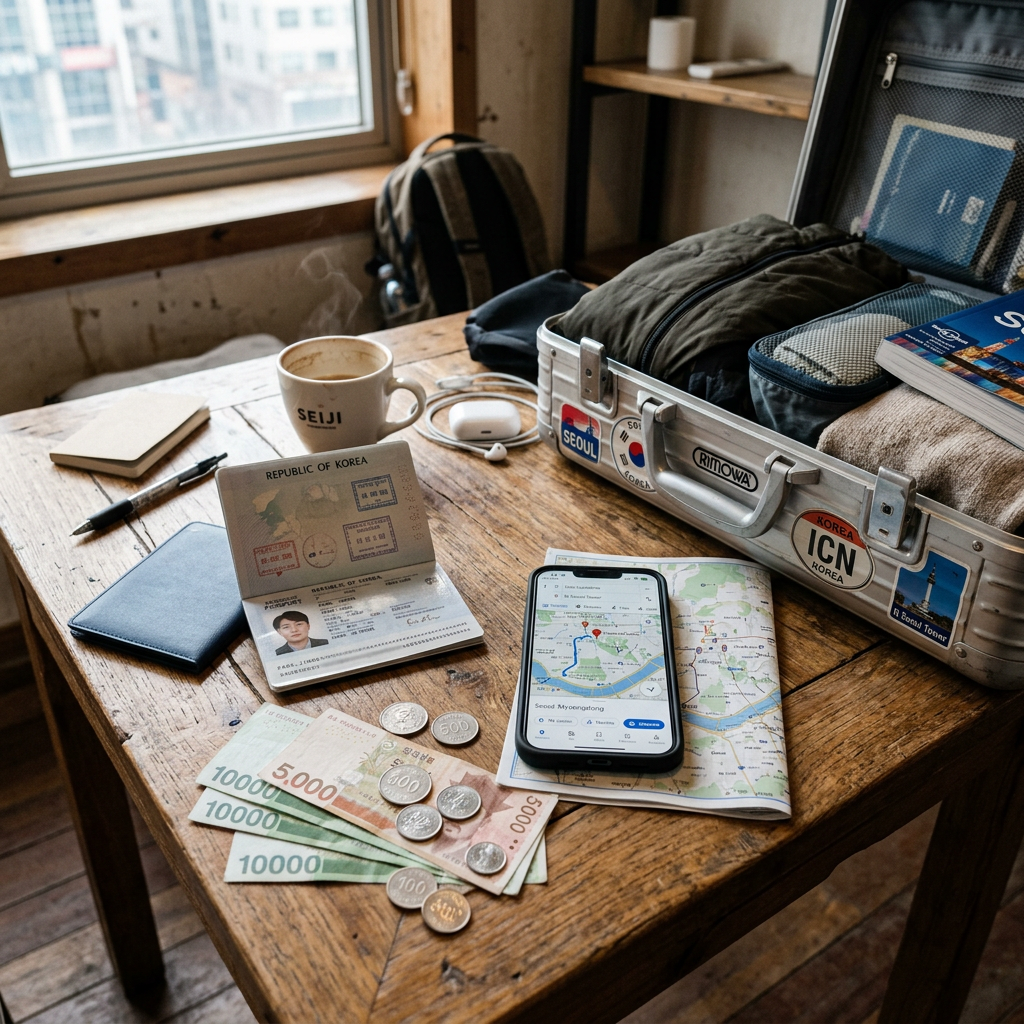

Planning your first trip to Korea can feel confusing at first. Before choosing restaurants, cafés, shopping streets, or day trips, it helps to set up a few basics first: your airport arrival plan, travel apps, payment methods, what to pack, how you’ll move between cities, and where to stay.
This starter guide is designed for foreign travelers who want to explore Korea without renting a car. Whether you are starting in Seoul, heading on to Busan or planning a Jeju trip, the guides below cover the setup that applies to all of it.
Korea is easy once you know how the system works. The usual first-trip problems are small ones: no plan for getting from the airport, map apps that do not work well here, no cash for a market stall, the wrong clothes for the season, or a hotel in an area that does not fit the trip.
Step 1: Choose Your Airport Arrival Guide
Most first-time visitors land at Incheon, near Seoul. Some fly directly into Gimhae Airport near Busan instead, especially if arriving from other parts of Asia. Pick the one that matches your actual arrival airport.
Incheon Airport Arrival Guide
Learn how to handle immigration, SIM cards or eSIM, currency exchange, and the fastest route from Incheon Airport into Seoul.
Read the Arrival GuideGimhae Airport to Busan Guide
Flying directly into Busan? This guide covers light rail vs. taxi, luggage delivery, foreign card issues, and getting to your hotel area.
Read the Gimhae Airport GuideStep 2: The Essentials Before You Explore

These four guides cover what to bring, how to communicate, how to pay, and where to sleep, the basics that make every neighborhood easier once they’re sorted out.
Korea Packing List
What to actually bring: documents, entry requirements, electrical adapters, seasonal clothing, and what to keep in your carry-on.
Read the Packing ListEssential Apps & Korean Phrases
Google Maps is not always enough in Korea. Get the right map, taxi, subway, and translation apps, plus useful Korean phrases for restaurants, taxis, and shopping.
Read the Apps GuideKorea Money Guide
How to use Korean won, credit cards, ATMs, transportation cards, and payment methods, especially useful for shopping, cafés, and local markets.
Read the Money GuideWhere to Stay in Korea
Compare the best areas in Seoul, Busan, and Jeju, plus room types, hotels, guesthouses, hanok stays, and booking tips for a smoother check-in.
Read the Accommodation GuideStep 3: Moving Between Cities
Once you’re settled, you may want to explore beyond Seoul. These two guides cover getting around day-to-day and traveling between major cities.
Korea Transportation Guide
The full picture: T-Money and Climate Card, the Seoul subway and buses, taxis, and an overview of intercity trains and airport transfers.
Read the Transportation GuideSeoul to Busan by KTX
Planning a trip to Busan? This guide covers booking, seat selection, avoiding backward-facing seats, and common mistakes on Korea’s most popular train route.
Read the KTX GuideWhy These Guides Matter
Most people start by listing places to visit. In Korea it works better to sort out the basics first. Once your arrival plan, apps, payment method, packing and accommodation are settled, every neighborhood is easier to enjoy.
| Before You Travel | Why It Matters in Korea | Best Guide to Read |
|---|---|---|
| Plan your airport arrival | Your first hour in Korea sets the tone for the whole trip. Knowing your SIM, money, and transport options before landing avoids stress. | Incheon Airport Guide or Gimhae Airport Guide |
| Pack the right things | Entry requirements, plug types, and seasonal weather in Korea are easy to get wrong without checking first. | Korea Packing List |
| Install the right apps | Some global apps do not work as well in Korea. Local map, taxi, and translation apps save time every day. | Essential Apps & Korean Phrases |
| Prepare payment options | Cards are widely used, but cash and transportation cards are still useful for small payments, markets, and transit. | Korea Money Guide |
| Choose the right area and room type | Hongdae, Myeongdong, Gangnam, Itaewon, and other areas all feel different. The right choice depends on your itinerary and travel style. | Where to Stay in Korea |
| Understand transportation day-to-day | Subway, buses, and taxis all work differently than what many visitors expect from home. | Korea Transportation Guide |
| Plan a trip to Busan | The KTX is fast and convenient, but booking, seating, and station navigation trip up first-timers. | Seoul to Busan by KTX |
Recommended Order for First-Time Visitors
If you do not know where to begin, follow this order:
- Pack and prepare before you fly. Check entry requirements, pack for the season, and know your airport arrival plan before you even board.
- Install travel apps. You will need them to search routes, restaurants, cafés, stations, taxis, and hotel locations.
- Check money and payment tips. Prepare your card, cash, and transportation payment before arriving.
- Compare neighborhoods and book your stay. Decide between Hongdae, Myeongdong, Gangnam, Itaewon, or other areas based on your itinerary, then pick a room type.
- Learn the transportation basics. Understand the subway, buses, and taxis before your first full day out.
- Plan any intercity trips. If Busan or another city is on your list, check the KTX guide before booking tickets.
Which Area Should You Start With?
For many first-time visitors, Seoul is the easiest starting point. From Seoul, you can explore major neighborhoods like Hongdae, Myeongdong, Seongsu, Gangnam, Itaewon, and Jongno without renting a car.
If you are young, interested in nightlife, shopping, street performances, cafés, and Korean beauty stores, Hongdae is one of the most practical first areas to visit. If you want classic shopping, street food, and easy access to N Seoul Tower, Myeongdong can be better. If you want trendy cafés, pop-up stores, and fashion brands, Seongsu is a strong choice.
Getting Online: SIM, eSIM or Wi-Fi
Mobile data is the one thing most first-time visitors sort out last, and it matters from the moment you land, because maps, translation and taxi apps all need a connection. There are four common ways to get online, and the right one depends on your phone and how many people share the connection.
| Option | Best For | Watch Out For |
|---|---|---|
| eSIM | Compatible phones, quick setup, late-night arrivals | Check that your phone supports eSIM before you buy |
| Physical SIM card | Travelers who want staff to help with activation | Your phone must be unlocked for overseas SIM use |
| Pocket Wi-Fi router | Families or groups sharing one device | You have to carry and charge it every day |
| International roaming | The simplest setup, with nothing to buy | Can cost more depending on your home carrier |
If you plan to use an eSIM, buy and install it before you fly, then switch it on after landing. That way you do not have to find an open counter after immigration. If you prefer a physical SIM or a router, pre-ordering for airport pickup is common, but counter locations and hours differ by terminal and provider. Screenshot the counter name and hours so you can check them on arrival. Free airport Wi-Fi is fine for loading a map or sending a message while you set things up, but it is public Wi-Fi and not a replacement for your own data.
For the airport-specific details, see our Incheon Airport arrival guide. Once you are online, the apps and phrases guide covers which apps to install first.
Simple Korea Travel Setup Checklist
| Checklist | Before Arrival | After Arrival |
|---|---|---|
| Airport arrival plan | Check SIM/eSIM options, entry requirements, and your airport-to-hotel route | Set up phone data and choose AREX, bus, or taxi to your hotel |
| Packing | Check seasonal weather, plug type, and entry document requirements | Keep valuables and first-day essentials in your carry-on |
| Map and transport apps | Install Naver Map or KakaoMap, a subway app, a taxi app, and a translation app | Save your hotel, airport route, and first destination |
| Payment | Prepare an overseas card and check fees | Get Korean won and a transportation card if needed |
| Neighborhood & room type | Compare areas and room types before booking | Confirm check-in time, deposit, and cancellation policy |
| Intercity travel | Check KTX booking windows if visiting Busan or another city | Confirm your train number, car, and seat before boarding |
Best For These Travelers
This starter guide is especially useful if you are:
- Visiting Korea for the first time
- Traveling without renting a car
- Planning to use subway, bus, taxi, and walking routes
- Staying in Seoul before visiting Busan, Jeju, or other cities
- Interested in Hongdae, Myeongdong, Seongsu, Gangnam, Itaewon, or local neighborhoods
- Shopping for K-beauty, fashion, snacks, souvenirs, and daily items
- Trying to avoid common first-day mistakes after landing at Incheon or Gimhae Airport
FAQ: Korea Travel Starter Questions
What should I read first before my Korea trip?
Start with the airport arrival guide that matches where you’re landing. Incheon for Seoul, or Gimhae for Busan. Then move on to packing, apps, money, and accommodation before planning your neighborhoods in detail.
Do I need special apps to travel in Korea?
Yes, it is strongly recommended. Korea is easy to travel in, but local map, transport, taxi, and translation apps can make your trip much smoother.
Can I travel around Korea without renting a car?
Yes. Seoul, Busan, and many major travel areas are easy to explore using subway, buses, trains, taxis, and walking. For first-time visitors, public transportation is often easier than driving.
Should I stay in Hongdae or Myeongdong?
Hongdae is better for nightlife, young energy, cafés, shopping, and airport access. Myeongdong is better for classic sightseeing, cosmetics shopping, street food, and easy access to central Seoul landmarks.
Should I fly into Incheon or Gimhae?
Most international routes connect through Incheon near Seoul. Gimhae, near Busan, has direct flights mainly from other parts of Asia. If your trip is Seoul-focused, Incheon is the natural choice. If Busan is your starting point, check whether a direct Gimhae flight is available before routing through Seoul.
Do I need cash in Korea?
Credit cards are widely used, but carrying some Korean won is still helpful for small shops, markets, street food, lockers, or backup situations.

Recommended first route:
Airport Arrival → Packing → Apps → Money → Where to Stay
Note: App features, transportation routes, hotel conditions, store hours, and payment policies can change. Always check recent information before your travel date.
Leave a Reply