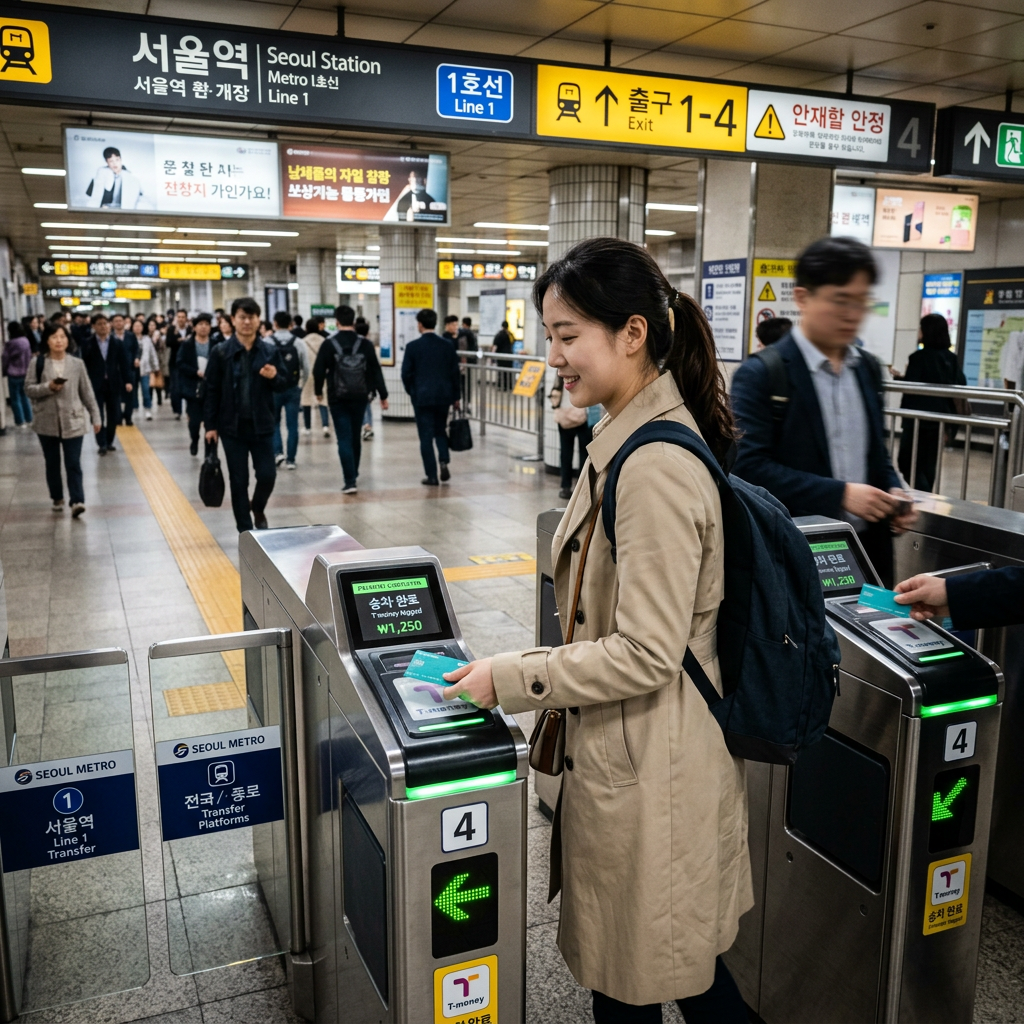
One of the best things about traveling in South Korea is that you do not need a car to see the country. The public transportation network here is among the most comprehensive in the world. It is punctual, affordable and easy to use once you understand a few core principles.
Subways connect every corner of Seoul. High-speed trains connect many major cities in just a few hours. Buses reach the places trains don’t. With the right card in your pocket and the right apps on your phone, you can travel from the royal palaces of Gyeongbokgung to the beaches of Haeundae without ever hailing a private car.
This guide covers everything in order. Keep it open as a quick reference during your trip.

📋 Table of Contents
- Transportation Cards in Korea
- How to Use the Seoul Subway
- How to Use Buses in Korea
- How to Use Taxis in Korea
- Traveling Between Cities: KTX & Trains
- Express and Intercity Buses
- Getting from Incheon Airport to Seoul
- Getting Around Busan
- Getting Around Jeju Island
- Essential Transportation Apps
- Transportation Etiquette in Korea
- Frequently Asked Questions
1. Transportation Cards in Korea
Before you board anything, subway, bus, or taxi, you need a transportation card. Cash is accepted in limited situations, but using a card is faster, cheaper, and almost universally expected. It also unlocks the integrated transfer discount system, which lets you switch between buses and subways without paying a full new fare each time.
There are two main options for international tourists: the T-Money card and the Climate Card short-term pass.
T-Money Card — The Go-Anywhere Standard
T-Money works everywhere. It is accepted on subways, city buses, intercity buses, most taxis, and even at many convenience store registers and vending machines throughout the entire country. If your trip includes more than one city, Seoul and Busan, for example, or a day trip to Jeju, T-Money is the card you want.
A standard T-Money card costs between 3,000 and 5,000 KRW to purchase, depending on the design. That price covers the card itself only, no transit credit is included at purchase. You add money separately before your first ride. Recharging at any convenience store counter takes about thirty seconds.
Where to Buy and Reload T-Money
| Location | Purchase Available | Reload Available | Accepted Payment |
|---|---|---|---|
| CU, GS25, 7-Eleven, Emart24 | ✅ Yes | ✅ Yes | Cash (KRW); some stores accept cards |
| Subway Station Ticket Machines | ✅ Yes (select machines) | ✅ Yes | Cash (KRW); some machines accept cards |
| Incheon Airport (T1 & T2) | ✅ Yes | ✅ Yes | Cash or card (varies by machine) |
| Tourist Information Centers | ✅ Yes (select locations) | ✅ Yes | Varies by location |
Practical tip: Always carry a small amount of Korean Won cash for topping up your card. Outside central Seoul, machines are less likely to accept international bank cards. Keeping a buffer of at least 3,000 to 5,000 KRW on your card at all times is a simple habit that saves headaches.
How the Transfer Discount System Works
When you take a bus in Korea and then switch to the subway (or another bus), you are not charged a full new fare, as long as you tap off the first vehicle before the transfer window closes. This is the integrated transfer discount, and it applies to T-Money users on eligible routes.
The step most people miss is tapping off the bus when they exit. Without that exit tap, the system cannot calculate your discount, and you will be penalized on your next ride. Always tap on and tap off.
| Time of Day | Transfer Window | Maximum Transfers |
|---|---|---|
| 7:00 AM – 9:00 PM | 30 minutes after exiting previous vehicle | Up to 4 total rides |
| 9:00 PM – 7:00 AM (next day) | 60 minutes after exiting previous vehicle | Up to 4 total rides |
Note: A transfer discount means you are not charged a new base fare, but if total journey distance increases significantly, a small additional distance-based charge may still apply.

Climate Card Short-Term Pass — Seoul’s Unlimited Ride Option
If you are spending several days entirely within Seoul and plan to use the subway and buses heavily every day, the Climate Card short-term pass is worth considering. Once activated, you can tap in and out as many times as you like on covered routes without any individual charges accumulating.
2026 update: Seoul’s separate 30-day Climate Card for residents was discontinued (recharging stopped at the end of July, and the old card stopped working from September 1). The 1, 2, 3, 5 and 7-day passes described below continue. Prices and rules can change, so check the Seoul Metropolitan Government’s official page before buying.
Passes begin on the day they are first used and run for consecutive calendar days from that point. The 3,000 KRW physical card fee is a one-time cost, on future trips, you only pay the pass fee itself.
| Pass Duration | Pass Fee | Physical Card Fee (one-time) | Total at First Purchase |
|---|---|---|---|
| 1-Day Pass | 5,000 KRW | 3,000 KRW | 8,000 KRW |
| 2-Day Pass | 8,000 KRW | 3,000 KRW | 11,000 KRW |
| 3-Day Pass | 10,000 KRW | 3,000 KRW | 13,000 KRW |
| 5-Day Pass | 15,000 KRW | 3,000 KRW | 18,000 KRW |
| 7-Day Pass | 20,000 KRW | 3,000 KRW | 23,000 KRW |
Climate Card Coverage Restrictions — Read This Before Buying
The Climate Card covers Seoul Metropolitan Government-licensed buses and eligible subway sections within the Seoul service area. However, several very common tourist routes fall outside its coverage:
- Sinbundang Line and GTX high-speed commuter lines
- Airport buses and airport limousine services
- Intercity and express buses
- Buses licensed by Incheon or Gyeonggi Province rather than Seoul
- Subway travel that crosses outside the designated Seoul service boundaries
🚨 Airport Note: Climate Card users may be able to exit at Incheon Airport Terminal 1 or Terminal 2 when boarding from within the eligible Seoul service area, but boarding at Incheon Airport using the Climate Card is not allowed. For your arrival-day journey into Seoul, use the AREX train with a separate ticket, an airport limousine bus, or a T-Money card where accepted.
Official Climate Card information: Coverage areas and payment rules may change. Check the Seoul Metropolitan Government’s official page before purchasing your pass.
T-Money vs. Climate Card — Which Should You Choose?
For most international tourists, T-Money is the safer default. It works everywhere without coverage restrictions. The Climate Card only makes sense if you are staying within Seoul’s covered network for several days and riding transit five or more times per day.
| Factor | T-Money Card | Climate Card (Short-Term Pass) |
|---|---|---|
| Coverage Area | Nationwide (Seoul, Busan, Jeju, and beyond) | Seoul eligible lines and buses only |
| Ride Limit | Pay-per-ride | Unlimited during pass period |
| Airport Bus | ✅ Accepted on most routes | ❌ Not covered |
| Intercity Travel | ✅ Works on many services | ❌ Not covered |
| Taxi Payment | ✅ Accepted by most taxis | ❌ Not accepted |
| Boarding at Incheon Airport | ✅ Yes | ❌ Not permitted |
| Best Suited For | Multi-city trips; light to moderate daily use | Seoul-only stays; 5+ transit trips per day |
Looking for WOWPASS, NAMANE, or general payment advice? Foreign card acceptance, ATMs, Apple Pay reliability, and how these tourist cards compare are covered in our money guide.
2. How to Use the Seoul Subway
Seoul’s subway system is one of the most extensive metro networks in the world, over 20 lines, hundreds of stations, and a coverage area that stretches far beyond the city limits into surrounding towns and satellite cities.
It looks overwhelming on a map, but in practice it is remarkably logical. Lines are color-coded and numbered. Every station has signage in Korean and English. Navigation apps show you exactly which train to board and which exit to use.
Official Seoul subway map: Before using the Seoul subway, check the latest English subway map from Visit Seoul. The PDF version is useful for understanding line colors, transfer stations, and terminal directions.
Seoul Subway Fare Guide
Seoul subway fares are calculated by distance. The base fare covers the first 10 kilometers, after which small incremental charges are added. Paying with a transportation card is cheaper than buying a single-use paper ticket.
| Distance | T-Money / Card Fare | Single-Use Ticket (Cash) |
|---|---|---|
| Basic fare (up to 10 km) | 1,550 KRW | 1,650 KRW |
| 10 km – 50 km | +100 KRW per additional 5 km | +100 KRW per additional 5 km |
| Over 50 km | +100 KRW per additional 8 km | +100 KRW per additional 8 km |
Fares above reflect the June 28, 2025 fare adjustment. Always confirm current rates at ticket machines or on the official Seoul Metro website before traveling.
Entering and Exiting the Subway
Hold your transportation card flat against the sensor panel at the fare gate. You will hear a beep and the gate will open. On T-Money, the gate screen shows the fare charged and your remaining balance, a useful check before you run out of credit.
When your train arrives at the destination station, tap your card again on the exit sensor. Always use the same card at both entry and exit, it is how the system calculates your fare and determines transfer discount eligibility.
Choosing the Correct Direction
Every subway line runs in two directions, labeled by the terminal station name at each end. Before walking down to the platform, check the overhead signs for the terminal station in your direction and verify it matches your navigation app.
If you are uncertain, wait on the platform and check the next station announcement on the electronic board before the doors close.
Transferring Between Subway Lines
At transfer stations, Seoul Station, Sindorim, Hongik University, and dozens of others, you can switch lines without exiting through the fare gate or paying again. Follow the overhead “Transfer” signs and look for the color and number of your next line.
Transfers between subway lines within the same continuous journey do not trigger a new base fare.
What to Do If You Enter the Wrong Platform
First check whether an internal passageway connects the platforms on both sides of the station. At some stations, the platforms are physically separated, which means you may need to exit and re-enter on the correct side.
The good news: eligible Seoul subway stations allow passengers to exit and re-enter the same station within 15 minutes without being charged a new base fare. If in doubt, press the intercom near the fare gate and ask: “I entered the wrong platform, can I cross to the other side without being charged again?”
Finding the Right Exit
Large Seoul stations can have ten or more numbered exits, and choosing the wrong one can add a ten-minute detour around a busy intersection. Always check your navigation app for the recommended exit number before passing through the fare gate.
Large yellow neighborhood maps posted near the fare area also show the surrounding streets and landmark positions for each exit. Confirming your exit number takes five seconds and saves several minutes of backtracking.
3. How to Use Buses in Korea
Buses extend the transit network into places the subway simply does not reach, residential back streets, hilltop neighborhoods, coastal routes in Busan, and the winding roads of Jeju. Even in Seoul, some destinations are easier by bus than by subway.
It takes about five minutes to learn how the system works.
Seoul Bus Types and Colors
Seoul’s buses are color-coded by route category, making it easy to identify which type you need at a glance.
| Color | Route Type | Coverage Area | Adult T-Money Fare |
|---|---|---|---|
| 🔵 Blue (간선) | Trunk Route | Major arterial roads connecting city-wide locations | 1,500 KRW |
| 🟢 Green (지선) | Branch / Feeder Route | Residential neighborhoods connecting to subway stations | 1,500 KRW |
| 🔴 Red (광역) | Wide-Area Express | Seoul city center to Gyeonggi Province suburbs; limited stops | 3,000 KRW |
| 🟡 Yellow (순환) | Circulation Route | City center loop routes (Jongno, CBD area) | 1,400 KRW |
| ⚫ Night Bus (N prefix) | Night Service | Key routes after subway closure (~midnight to 5:30 AM) | ~2,300 KRW |
Adult card fares are based on Seoul Metropolitan Government official rates. Children and youth fares differ. Confirm current fares at bus stops or the Seoul Bus official website before traveling.
The Two-Tap Rule — Never Skip the Exit Tap
You must tap your transportation card when boarding and again when exiting. The exit tap is not optional. It triggers your transfer discount and calculates the correct distance-based fare.
If you step off without tapping, the system assumes you rode the maximum possible distance, and you will be charged accordingly on your next ride. Set a mental reminder: board and tap, exit and tap.
How to Request a Stop
As your destination approaches, move toward the rear exit doors and press one of the red STOP buttons on the handles or walls. Most buses in Seoul and major cities announce stops in both Korean and English.
If the button is not pressed and no one is waiting at the stop, the driver will not stop. Press the button as soon as you hear the announcement for your stop, do not wait until the last moment.
When Transfer Discounts Apply and When They Don’t
| Transfer Combination | Discount Applied? |
|---|---|
| Local bus → Subway (within transfer window) | ✅ Yes: base fare discount applies |
| Subway → Local bus (within transfer window) | ✅ Yes: base fare discount applies |
| Local bus → Different local bus (within window) | ✅ Yes: base fare discount applies |
| Local bus → Airport limousine or express bus | ❌ No: separate full fare required |
| Local bus → Intercity bus | ❌ No: separate full fare required |
4. How to Use Taxis in Korea
Korean taxis are metered, generally safe, and widely available in cities. They are not the cheapest option for solo travelers, but they solve specific problems well, getting somewhere at 1 AM after the subway has closed, hauling luggage across the city, or reaching a spot with no nearby station.
For groups of three or four people splitting the cost, a taxi can sometimes be competitive with transit fares.

Types of Taxis Available
| Type | Color (Seoul) | Starting Fare (Approx.) | What Makes It Different |
|---|---|---|---|
| Regular Taxi (일반택시) | Orange or white (varies by region) | ~4,800 KRW (first 1.6 km) | Most common; metered; available day and night |
| Deluxe Taxi (모범택시) | Black with yellow stripe | ~7,000 KRW (first 3 km) | Higher-grade vehicles; professionally licensed drivers |
| Large Taxi (대형택시) | Black | ~7,000 KRW | Fits 6–7 passengers; great for large groups with luggage |
| International Taxi | Black | Metered; varies | Drivers who speak English, Chinese, or Japanese |
A night surcharge of approximately 20% is added to regular taxi fares between 10:00 PM and 4:00 AM. The surcharge is applied automatically by the meter, no calculation needed on your part.
The Easiest Ways to Get a Taxi
| Method | How It Works | Best Suited For |
|---|---|---|
| Kakao T App (recommended) | Set pickup point and destination on map; driver matched automatically | All visitors; no Korean required; upfront fare estimate shown before confirming |
| Street Hail | Stand near a taxi stand or roadside; wave when available light is on | Busy areas where taxis pass frequently |
| Hotel or Accommodation | Ask front desk staff to call a taxi or write destination in Korean | When you need communication assistance |
| Official Taxi Stand | Queue at the marked stand; meter must be used from the start | Arrivals at Incheon Airport, Gimpo Airport, Seoul Station |
Safety Tips for Taxi Users
- Always ensure the driver starts the meter as soon as the car begins moving. It is legally required.
- At airports and major stations, board exclusively from the official taxi stand. Never accept a ride from someone who approaches you before you reach the stand.
- T-Money cards and most major credit cards are accepted in Seoul taxis. Confirm before departure if you plan to pay by card.
- To communicate a destination, show the address display in Naver Map or use Papago’s camera translation.
- Lost something in a taxi? Call the Seoul Taxi Lost & Found line at 120, which offers English assistance.
5. Traveling Between Cities: KTX & Trains
When you are ready to leave Seoul and explore the rest of the country, South Korea’s intercity rail network becomes your best friend. The KTX (Korea Train Express) is the flagship high-speed line, connecting Seoul to major cities across the country with impressive speed and comfort.
Standard trains, ITX-Saemaeul and Mugunghwa, serve smaller cities at more affordable fares and slightly longer travel times. Between the two systems, almost every significant destination on the Korean peninsula is reachable by rail.

KTX Routes and Approximate Travel Times from Seoul
| Destination | Approx. Travel Time | Approx. Standard Fare | Notes |
|---|---|---|---|
| Busan | 2h 15min – 2h 40min | ~59,800 KRW | Gyeongbu KTX line; most popular intercity route in Korea |
| Daejeon | ~50 minutes | ~23,700 KRW | Also served by SRT from Suseo Station |
| Daegu | ~1h 40min | ~38,900 KRW | Gyeongbu KTX line |
| Gyeongju (Singyeongju Stn) | ~2h | ~46,600 KRW | Bus or taxi needed from station to city center (~30 min) |
| Gwangju (Songjeong Stn) | ~1h 30min | ~35,400 KRW | Honam KTX line; transfer to city bus for downtown |
| Mokpo | ~2h 30min | ~46,500 KRW | Honam KTX; gateway to the Dadohae island chain |
| Jeonju | ~1h 40min – 2h | Varies by train type | KTX and standard train services available; check Korail for current options |
Fares shown are approximate standard-class one-way figures subject to change. SRT (Super Rapid Train) operates a parallel high-speed service from Suseo Station in southeastern Seoul at slightly different prices. Always check Korail or SRT for current schedules and fares.
Taking the Seoul–Busan route specifically? Seat classes, booking steps, how to avoid backward-facing seats, foreign card payment issues, and what to do if your train is sold out are all covered in detail in our dedicated guide.
For any other route, the booking process works the same way. The official Korail website and Korail Talk app both offer full English interfaces, and tickets open exactly one month before departure. Book early for weekends and especially for Lunar New Year (설날) and Chuseok (추석), when tickets can sell out within hours.
Official KTX booking: Train schedules, fares, and seat availability change by date. Use Korail’s official English website to search routes and book tickets directly.
Korail Pass — Unlimited Rail Travel for Foreign Visitors
Foreign passport holders have access to the Korail Pass, a special unlimited rail travel pass that Korean residents cannot use. It provides unlimited rides on KTX and standard trains for a set number of days and can deliver real savings if your trip covers several cities beyond just Seoul and Busan.
| Pass Type | Duration Options | Where to Purchase |
|---|---|---|
| Consecutive Days Pass | 2, 3, 4, or 5 consecutive days | Korail website, Incheon Airport service counter, select overseas travel agents |
| Flexible Days Pass | 2 or 3 flexible days within any 10-day window | Korail website, Incheon Airport service counter |
Current pricing is listed on the official Korail website and is updated periodically. Note that the Korail Pass does not cover SRT services, and seat reservations for specific trains may carry a small additional fee on top of the pass cost.
6. Express and Intercity Buses
Not every destination in Korea sits on a train line. For coastal towns, inland valleys, and smaller cities, the express bus network fills the gap, and does so with more comfort than you might expect. Premium and Premium-Gold buses offer wide, fully reclining seats and individual entertainment screens, making four-hour journeys comfortable.
For certain routes, particularly to the southwest of the country, buses can actually be faster than available train options when you account for transfers.
Major Bus Terminals in Seoul
| Terminal Name | Subway Access | Primary Destinations Served |
|---|---|---|
| Seoul Express Bus Terminal (센트럴시티) | Lines 3, 7, 9: Express Bus Terminal Station | Gwangju, Jeonju, Mokpo, Jinju, Gyeongju, Buan, Naju |
| Dong Seoul Bus Terminal (동서울) | Line 2: Gangbyeon Station | Sokcho, Gangneung, Chuncheon, Wonju, Andong, Pohang |
| Nambu Bus Terminal (남부) | Line 3: Nambu Terminal Station | Suncheon, Yeosu, Hadong, Namhae, Tongyeong |
Bus Classes and What to Expect
| Class | Seats Per Coach | Features | Best For |
|---|---|---|---|
| Regular Express (일반) | 45 seats | Standard reclining seats | Short to mid-distance budget travel |
| Premium (우등) | 28 seats | Wider reclining seats; individual screen; more legroom | Comfortable journeys of 3–4 hours |
| Premium Gold (프리미엄) | 21 seats | Near-flat reclining; widest seats; premium comfort | Long-distance routes over 4 hours or late-night travel |
Terminal kiosks have full English menus, making walk-up ticket purchase straightforward. For popular weekend routes, booking ahead through Bustago (bustago.or.kr) or Kobus (kobus.co.kr), both available in English, is worth the extra few minutes of planning.
7. Getting from Incheon Airport to Seoul
Incheon International Airport is located on a reclaimed island roughly 50 kilometers west of central Seoul, which means your transit journey into the city begins the moment you clear customs.
There are four reliable methods to choose from, each with its own strengths. The right choice depends on where in Seoul you are headed, how much luggage you are carrying, what time you arrive, and how much you want to spend.
Official airport railroad information: AREX train times, last departures, and ticket details can vary by date and terminal. Check the official Airport Railroad website before arrival to confirm current schedules.
| Method | Travel Time | Approx. Fare | Card Accepted | Best Suited For |
|---|---|---|---|---|
| AREX Express Train (non-stop) | ~43 minutes | ~11,000 KRW one-way | Separate ticket required | Fastest route to Seoul Station; assigned seating; recommended for first-timers |
| AREX All-Stop Train | ~60–70 minutes | ~5,150 KRW | ✅ T-Money accepted | Budget travelers; useful if destination is near an intermediate station |
| Airport Limousine Bus | ~60–90 min (traffic-dependent) | ~17,000–25,000 KRW | ✅ T-Money on select routes; cash available | Heavy luggage; drops off near major hotels and districts |
| Regular Taxi | ~60–90 minutes | ~65,000–90,000 KRW | ✅ T-Money / Credit card | Groups of 3–4 splitting the fare; late-night arrivals |
| Deluxe / International Taxi | ~60–90 minutes | ~80,000–120,000 KRW | ✅ Credit card | English-speaking driver or higher-grade vehicle needed |
Practical note: The AREX All-Stop train does not run all night. If you land late, check the last departure time on the official AREX website before your flight. Airport Limousine Buses run later on most routes, and taxis are available around the clock. The Kakao T app works at Incheon Airport and is the easiest way to book a metered taxi without language difficulty.
Landing at Incheon for the first time? SIM card counters, currency exchange, luggage storage, and a full first-day walkthrough are covered in our dedicated arrival guide.
8. Getting Around Busan
South Korea’s second city feels like a completely different country from Seoul, a port city built vertically into hills, with beaches, fish markets, and hillside murals woven between high-rise apartments. Busan has its own well-developed subway and bus network that connects the most popular tourist destinations.
Some of the more scenic spots require a local bus rather than the subway. Your T-Money card works seamlessly throughout the city.

Busan Subway Lines and Key Tourist Stops
| Line | Color | Key Stops for Tourists |
|---|---|---|
| Line 1 | 🟠 Orange | Busan Station, Nampo, Jagalchi Fish Market, Seomyeon, Dongnae, Nopo |
| Line 2 | 🟢 Green | Seomyeon, Gwangalli, Haeundae Beach, BEXCO, Centum City, Sasang |
| Line 3 | 🟤 Brown | Suyeong, Yeonsan, Daejeo |
| BGL (Gimhae Light Rail) | 🟣 Purple | Gimhae Airport ↔ Sasang Station (transfer point for Line 2) |
All Busan subway lines accept T-Money cards, but fares follow Busan’s own local fare system rather than Seoul’s exact fare structure. Station signage and train announcements are available in Korean and English throughout the network.
Line 1 is the most useful line for first-time visitors, connecting Busan Station, the Nampo and BIFF Square area, and Jagalchi Fish Market in a single ride.
Arriving via Gimhae Airport (PUS)?
If your trip starts by flying directly into Busan rather than connecting through Seoul, getting from Gimhae Airport into the city involves the BGL Light Rail, a transfer at Sasang Station, and a choice between light rail, limousine bus, or taxi depending on your luggage and budget.
Full airport arrival breakdown: Light rail vs. taxi costs, luggage delivery services, foreign card payment issues, and what to do if you land late are all covered in our dedicated guide.
Practical Tips for Getting Around Busan
- From Busan Station, take Line 1 south toward Nampo or Jagalchi for the fish market area. For Haeundae Beach, Gwangalli, and Centum City, ride Line 1 to Seomyeon and transfer to Line 2 toward Jangsan. Haeundae station is on this line.
- Gamcheon Culture Village, Taejongdae, and Igidae Coastal Park are best reached by local bus rather than subway, open Naver Map for accurate real-time Busan bus routes.
- The Busan City Tour Bus (hop-on/hop-off) is a convenient starting point for first-time visitors who want to cover multiple areas in one day.
9. Getting Around Jeju Island
Jeju operates completely differently from the mainland. There is no subway. The island’s public bus network covers most major tourist sites, but the geography, wide spaces between attractions, winding coastal roads, and volcanic terrain, makes car rental appealing for travelers who want maximum flexibility.

Jeju’s Bus Network
Jeju operates an integrated bus system with three route types. T-Money cards are accepted on all of them, and the transfer discount rules follow the same principles as the mainland. Bus frequency outside central Jeju City and Seogwipo can be limited, checking timetables in Naver Map before planning your day is worthwhile.
| Bus Type | Color | Coverage | T-Money Fare |
|---|---|---|---|
| Express Bus (급행) | 🔴 Red | Jeju City ↔ Seogwipo and major hubs; limited stops; fastest service | ~3,000 KRW |
| Trunk Bus (간선) | 🔵 Blue | Connects towns, tourist sites, and key points across the island | ~1,500 KRW |
| Branch Bus (지선) | 🟢 Green | Local neighborhood and village routes; lower frequency | ~1,150 KRW |
Car Rental in Jeju — What You Need to Know
Renting a car is the most flexible way to explore Jeju’s waterfalls, crater lakes, lava tube caves, and remote coastal stretches. The roads are straightforward, traffic is lighter than on the mainland, and most rental agencies at Jeju International Airport (CJU) have English-speaking staff.
| Requirement | Details |
|---|---|
| Driver’s License | Valid home country driver’s license required |
| International Driving Permit (IDP) | Required for foreign nationals: must be obtained in your home country before departure; cannot be issued inside Korea |
| Minimum Age | Typically 21 years old; some agencies require 26 for certain vehicle categories |
| Driving Side | Right side of the road (same as USA, Canada, most of Europe, China) |
| Speed Limits | Expressways: 80–100 km/h · Urban roads: 50–60 km/h · School zones: 30 km/h |
| Rental Pickup | Major international and domestic agencies operate counters at Jeju International Airport (CJU) |
10. Essential Transportation Apps for Travelers
There is one thing you need to understand about navigation in South Korea before you arrive: Google Maps works for looking up places, but its walking and transit directions are very limited in Korea. Due to government map-data restrictions, it cannot give the detailed routing that Korean apps can.
Download the apps below before your flight, or at minimum while connected to airport Wi-Fi the moment you land.
| App | Platform | Languages | What It Does | Priority |
|---|---|---|---|---|
| Naver Map | iOS & Android | Korean, English, Chinese, Japanese | Walking directions, transit routing, real-time bus arrivals, restaurant info: the single most important navigation app for Korea | ⭐ Essential |
| KakaoMap | iOS & Android | Korean, English | Alternative navigation; excellent local business data; useful backup to Naver Map | ⭐ Recommended |
| KakaoMetro / Subway Korea | iOS & Android | Korean, English | Subway route planning; real-time arrivals; shows optimal boarding door for faster transfers | ⭐ Essential |
| Kakao T | iOS & Android | Korean, English | Taxi booking with upfront fare estimate; no Korean required; safest way to hail a cab | ⭐ Essential |
| Papago | iOS & Android | Multiple languages | Korean translation via text, voice, or camera; invaluable for menus, signs, and communication | ⭐ Essential |
| Korail Talk | iOS & Android | Korean, English | KTX and intercity train ticket search, booking, and management | ✅ For intercity rail |
| Bustago / Kobus | iOS, Android, Web | Korean (some English) | Express and intercity bus ticket booking in advance | ✅ For intercity bus |
Connectivity matters: All of these apps depend on a live data connection for real-time transit information. Purchasing a Korean SIM card or renting a pocket Wi-Fi device at Incheon Airport is strongly recommended. Major carriers. SKT, KT, and LG U+, all have service counters in the arrivals hall at both terminals, and most offer prepaid tourist SIM plans that can be activated in minutes.
Want survival Korean phrases too? Useful phrases for taxis, restaurants, and emergencies, plus a closer look at each app above, are covered in our dedicated apps and phrases guide.
11. Transportation Etiquette in Korea
Public transportation in Korea is a shared, structured experience with unwritten social norms that most locals follow without thinking. Visitors who observe these habits tend to have a much smoother experience and avoid unintentional friction.
None of the rules below are difficult, they mostly come down to awareness and consideration for other passengers.
| Situation | What Is Expected |
|---|---|
| Priority seats | Seats marked in a different color near the doors are reserved for elderly passengers, pregnant women, people with disabilities, and those with young children. Even when empty during off-peak hours, it is widely considered inappropriate for able-bodied adults to sit in them. |
| Food and drinks | Eating on subways is not permitted and is considered impolite. Strong-smelling snacks are particularly problematic in enclosed train cars. A sealed water bottle used discreetly is generally tolerated in practice. |
| Phone calls and audio | Keep phone call volume low and step into the vestibule area between cars for longer calls. Headphones are expected when listening to music or video. Using your phone’s speaker in a subway car is considered rude. |
| Boarding order | Let all passengers exit the train or bus completely before stepping on. Stand to the sides of the subway doors while waiting: forming two lines is the norm at busy stations. Do not block the center of the doorway. |
| Escalators | Stand on the right side and leave the left side clear for passengers who prefer to walk. This convention is deeply ingrained throughout the country, though some Seoul stations are trialing a stand-on-both-sides policy. |
| Quiet zones on KTX | Certain KTX cars are designated quiet zones where phone calls and loud conversation are prohibited. Check your ticket or the car indicator board at the entrance to confirm whether you are in a quiet zone. |
| Luggage placement | Place bags and suitcases in overhead racks or at the end sections of subway cars rather than blocking the aisle. Traveling with large luggage during rush hour (8–9 AM and 6–7 PM on weekdays) is strongly discouraged. |
12. Frequently Asked Questions (FAQ)
Can I top up my T-Money card using an international credit card?
In most cases, no. Standard T-Money cards are reloaded with Korean Won cash at convenience store counters and subway ticket machines. Some newer Climate Card vending machines inside subway stations do accept internationally issued credit and debit cards, but this is not guaranteed everywhere.
The safest approach is to keep a small amount of Korean Won cash specifically for recharging your card, the reload process takes about thirty seconds at any convenience store.
What happens if my T-Money card runs out of credit mid-journey?
The exit fare gate will alert you if your balance is insufficient. You will need to add credit at a nearby reload machine before passing through. Some gates may allow a small negative balance temporarily depending on the station, but this varies.
A practical habit is to keep a minimum buffer of 3,000 to 5,000 KRW on your card at all times so you are never caught short.
Can I use Apple Pay, Samsung Pay, or a contactless bank card on Korean transit gates?
As of June 2026, most Korean subway gates and bus readers do not accept direct contactless payment from international bank cards, Apple Pay, or Samsung Pay as a transit fare method. T-Money remains the standard payment method.
This is a developing area, so checking the Seoul Metro website for the latest updates before your trip is worthwhile.
Is it acceptable to travel with a large suitcase on the Seoul subway?
It is permitted, and plenty of travelers do it. However, the subway is very crowded during peak hours, 8:00 to 9:00 AM and 6:00 to 7:00 PM on weekdays, and maneuvering a large suitcase through busy cars and staircases during those windows is unpleasant for everyone.
If possible, plan luggage-heavy journeys for mid-morning or early afternoon. Many tourists also use Korea’s affordable luggage delivery services (짐 배송), which pick up and deliver bags between hotels and airports within the same or next day.
What time does the Seoul subway close, and what are my options after midnight?
Most Seoul subway lines stop running between midnight and 1:00 AM, with exact times varying by line. Service resumes from approximately 5:30 AM. After the subway closes, Night Buses, identified by the letter N before the route number, operate on select major routes through the early morning hours.
Taxis are available all night and can be booked conveniently through the Kakao T app, which also provides a fare estimate before you confirm the ride.
Do I need to book KTX seats in advance, or can I buy tickets at the station?
For mid-week travel on less popular routes, same-day and walk-up tickets are often available at station kiosks. For any weekend journey, and absolutely for travel during the Lunar New Year (설날) or Chuseok (추석) holiday periods, tickets sell out weeks in advance.
Korail generally allows ticket purchases from 7:00 AM one month before your departure date. Booking online through the Korail website or app as early as possible is the safest approach.
Is the Seoul subway safe for solo travelers and for women traveling alone?
Yes, consistently so. The Seoul subway is widely cited as one of the safest metro systems in the world. Comprehensive CCTV coverage, security personnel, and emergency intercoms are present at all stations.
Some Seoul subway lines offer women-only cars at the ends of the train during morning and evening rush hours, these are clearly marked by pink signage on the platform.
Can I get a refund on unused T-Money credit when I leave Korea?
Yes. You can claim a refund of your remaining T-Money balance, minus a small handling fee (typically 500 KRW), at designated convenience store counters or subway station service centers. Bring your T-Money card and passport when requesting the refund.
Not all stores process T-Money refunds, so it is worth asking specifically before queuing.
Does the KTX stop at Incheon Airport?
No. The KTX network does not serve Incheon Airport directly. To travel from the airport to cities like Busan or Daejeon by KTX, take the AREX train to Seoul Station first, then board the KTX there.
Alternatively, the SRT high-speed train departs from Suseo Station in southeastern Seoul, reachable from the airport via the AREX All-Stop train and a subway connection. Plan for at least 90 minutes between landing and your KTX departure to allow for transit time and any delays.
Is it safe to hail a taxi off the street in Korea?
Licensed Korean taxis are generally safe and metered. The main risk for tourists is accepting rides from unlicensed drivers who may approach you in tourist areas or outside airports, always ignore these approaches and proceed to the official taxi stand.
For maximum transparency and safety, booking through the Kakao T app is strongly recommended: it records your route, driver ID, and estimated fare before you get in the car.
Which navigation app should I use if I only want to download one?
Download Naver Map. It supports comprehensive English navigation, real-time bus arrivals, accurate walking paths, and transit routing throughout South Korea. It is the most complete single tool available for foreign travelers and will cover the vast majority of navigation needs during your trip.
Papago for translation and Kakao T for taxis are the other two that make the biggest practical difference.
The transportation information in this guide was reviewed and updated in June 2026. Routes, fares, operating hours, card coverage, and app availability may change at any time. Always verify current details through official transit authority websites, ticket machines, or station information counters before making decisions for your journey.
Leave a Reply