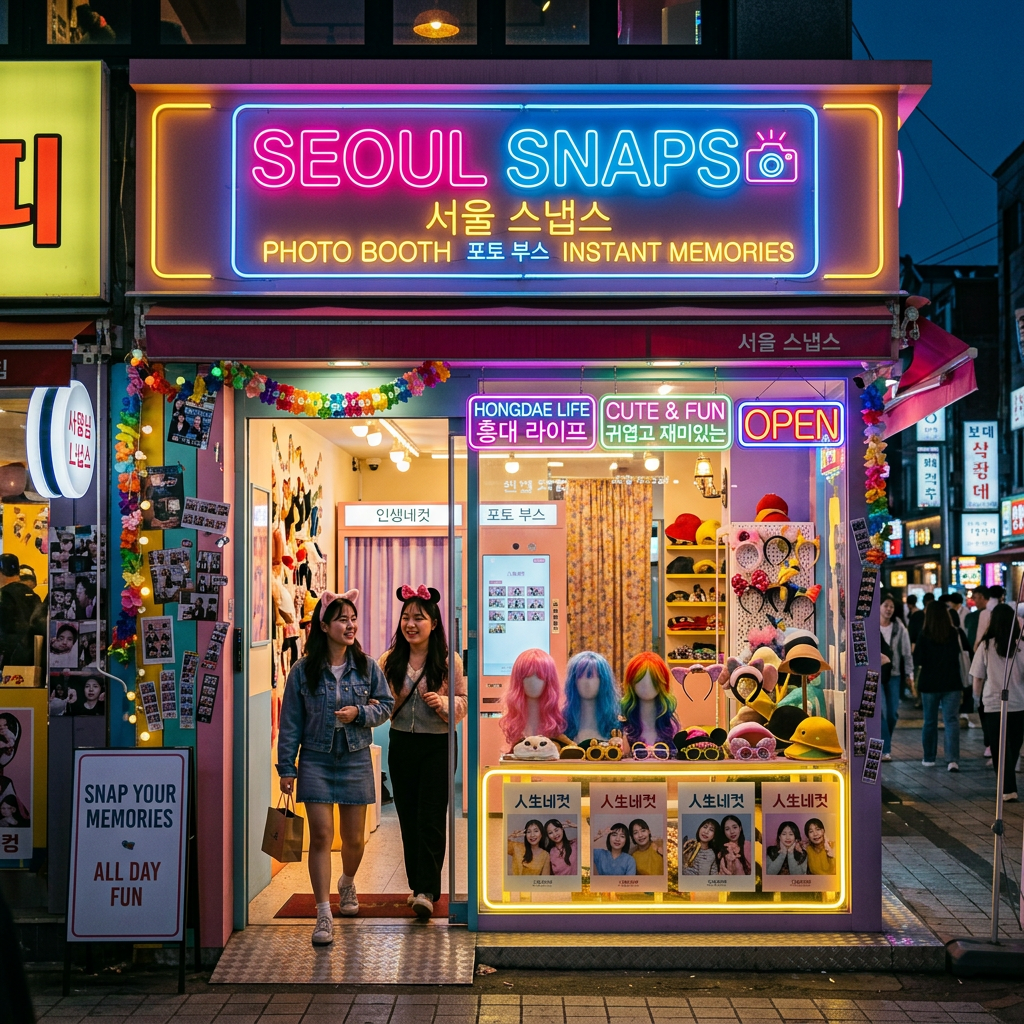

Somewhere between the cafés and the cosmetics shops, nearly every busy street in Seoul has a glowing, unstaffed storefront packed with mirrors, prop baskets, and curtained booths. This is the four-cut photo studio, and doing one has quietly become as standard a Seoul activity as visiting a palace or walking along the Han River.
This guide covers what these places actually are, how the process works, which brands are worth knowing, and where to find the best ones.
1. What “Insaeng Necut” Actually Means
The term you’ll see everywhere is insaeng necut (인생네컷), a portmanteau of insaeng sajin (인생사진, “the photo of your life”) and necut (네컷, “four frames”). It started as the name of a specific brand, Life Four Cuts, back in 2017. Since then, the phrase has become generic, similar to how “Kleenex” gets used for tissues regardless of brand. Ask a Korean teenager to “go take necut” and which actual brand you end up at is beside the point.
What makes these different from a passport-photo booth back home is the setup: professional-style lighting, cinematic filters, free costume props, and a genuine design culture built around the printed strip itself. It’s grown into a proper industry too, with South Korea’s self-photo booth segment estimated at roughly $400 million in 2024 and projected to keep growing fast through the rest of the decade.
2. How It Works, Step by Step

| Step | What Happens |
|---|---|
| 1. Walk in | These are self-service studios, no staff required. Pay at a kiosk or vending-style machine at the entrance |
| 2. Choose a frame style | Pick a background, filter, or themed set, sometimes including collaboration designs tied to K-pop groups or characters |
| 3. Pose | Step into the booth and pose through a countdown, usually capturing 8–10 frames over about a minute |
| 4. Pick your favorites | Review the shots on a screen and select your best four for the final strip |
| 5. Print and go | The machine prints two paper strips, and a QR code on the print unlocks the digital files and a short video clip |
3. The Major Brands and What Sets Them Apart
| Brand | Known For |
|---|---|
| Life Four Cuts | The original brand that started the whole trend, still the most widely recognized name and the easiest to find |
| Photoism | Known for celebrity and K-pop idol collaboration frames, with flagship “Photoism Box” locations that lean into fan culture |
| Photogray | Popular for cooler, more editorial-style filters and sophisticated lighting, a favorite in Anguk-dong and Seongsu |
| Haru Film / Harupict | Known among younger users for distinctive retouching styles and frequently rotating frame designs |
You don’t need to research this in advance. Any of the major brands will get you a solid result, and half the fun of trying a few is noticing how different the lighting and filter style feel from one to the next.
One thing worth knowing going in: most brands apply some degree of automatic skin-smoothing and light retouching to every shot, and how strong that effect is varies noticeably from brand to brand. Don’t be surprised if the printed strip looks a bit more polished than your actual reflection. This is standard and expected, not a glitch.
4. Best Neighborhoods to Try One

| Neighborhood | Why Go Here |
|---|---|
| Hongdae | The highest concentration of booths in Seoul, clustered around Hongik University Station — the easiest place to just wander into one |
| Seongsu | The most curated, design-forward brands and sets, fitting with the neighborhood’s overall aesthetic |
| Gangnam | Plenty of options with noticeably shorter lines on weekday afternoons |
| Myeongdong & Sinchon | Convenient if you’re already shopping or exploring these areas, with several branches within walking distance of each other |
| Bukchon | Booths here are more likely to offer foreign-language support, and pairing one with a hanbok rental makes for a distinctive strip |
5. Practical Tips for Your First Strip
- No Korean needed. The touchscreen interfaces are simple enough to navigate through icons and previews alone, and the process is identical regardless of language.
- Groups work fine. Booths are sized for a few people at once, making this an easy activity to fit into a day out with friends rather than something you need to do solo.
- Save your QR code right away. It’s printed on your strip and gives you the full-resolution digital versions plus a short video clip, but the download link typically expires within a few days, so scan it and save the files before you forget rather than treating it as a permanent link.
- Do more than one. Since the strip captures a specific place and date, trying one in a lively area like Hongdae and another somewhere more personal, like near your hotel on your last night, gives you two genuinely different souvenirs rather than duplicates.
- Prices are cheap but add up per copy. A basic two-strip print typically runs around 4,000 KRW, with additional copies or premium frame styles costing a bit more.

Note: Brands, locations, prices, and available frame designs change often and vary by store. Treat this as a general guide to the experience rather than a fixed price list.
Leave a Reply